Mobiles for Development is a research study commissioned by UNICEF to help the organization understand the global mobile telephony landscape as it relates to advancing development, and as an area of significant future opportunities.
Evidence for the report comes from UNICEF operational staff and representatives of mobile operators in 14 countries (Bangladesh, Egypt, Ghana, Iraq, Kosovo, Lao PDR, Malawi, Mongolia, Philippines, Sierra Leone, Sri Lanka, Suriname, Uganda, and Zambia). The report suggests that mobile tools can identify the most deprived children and communities, provide cost effective iinterventions, overcome bottlenecks to services, and enable communities to maximize the impact of available resources.
Showing posts with label Reports - Books. Show all posts
Showing posts with label Reports - Books. Show all posts
Friday, March 25, 2011
Mobiles for Development data sheet

Treatment of TB: Progress report 2011
This new WHO report underlines the need for countries to implement all necessary measures to address multidrug-resistant tuberculosis (MDR-TB) , otherwise the universal access target, set by the World Health Assembly in 2009, will not be achieved by 2015, with the loss of hundreds of thousands of lives.
http://whqlibdoc.who.int/publications/2011/9789241501330_eng.pdfMonitoring and Evaluation Tools, Methods and Approaches
Government officials, development managers and civil society are increasingly aware of the value of monitoring and evaluation (M&E) of development activities. M&E provides a better means of learning from past experience, improving service delivery, planning and allocating resources, and demonstrating results as part of accountability to key stakeholders. Yet there is often confusion about what M&E entails. This booklet therefore presents a sample of M&E tools, methods and approaches, including several data collection methods, analytical frameworks, and types of evaluation and review. For each of these, a summary is provided of the following: their purpose and use; advantages and disadvantages; costs, skills, and time required; and key references.
http://web.worldbank.org/WBSITE/EXTERNAL/EXTOED/EXTEVACAPDEV/0,,contentMDK:22293257~menuPK:4585754~pagePK:64829573~piPK:64829550~theSitePK:4585673,00.htmlNew & Emergent ICTs and Climate Change in Developing Countries
Analyses the climate change application of new and emergent ICTs – wireless broadband, wireless sensor networks, GIS, Web-based tools – in developing countries. Identifies major uses in disaster management and climate monitoring, and lacunae around climate adaptation. Provides recommendations for more effective use of new digital technology.
http://www.niccd.org/KaranasiosClimateChangeEmergentICTs.pdfTrocaire: 10 things INGOs need to do
(Excerpted from Trocaire's publication, Leading Edge 2020: Critical Thinking on the Future of International Development. You can read the full document here. HT @DochasNetwork.)
In order to meet the challenges of the changing global context, international non-governmental organizations (INGOs) need to:
1. Do more and better advocacy, harnessing their potential to bring about change. Advocacy must be evidence-based using local knowledge and stronger analysis. INGOs must work in collaboration, ensure their advocacy is partner-led and informed by the work on the ground, and work in closer partnership with the South, supporting rather than stifling or usurping the voices of their Southern partners.
2. Ensure downward accountability towards those they serve. INGOs have played a powerful role in holding governments and international organisations to account, but have not always been as stringent in their own accountability. It is essential they place as much emphasis on their accountability to the needs of the people they serve as they do to those who fund their work, involving partners more in shaping their policies and decisions. They must not confer false legitimacy on all Southern NGOs without questioning who they represent and they must develop a shared vision of partnership, where key decisions are taken together.
3. Become more flexible and responsive. This means being able to shift resources and focus as priorities change – without falling into the trap of reacting to fads or temporary trends. They must invest time and money in critical thinking and learning that will allow them to discern new challenges. They must work with other INGOs to remove rigid frameworks, which make it difficult to shift priorities.
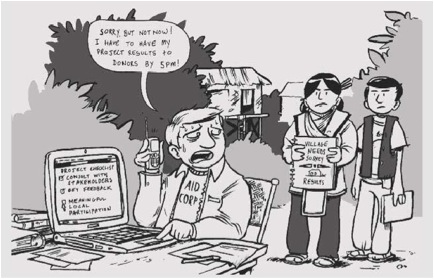
"Sorry but not now! I have to have my project results to donors by 5pm!" An illustration from Trocaire's Leading Edge 2020 report
4. Engage with power and politics and how they influence the contexts in which they work at home and abroad. They need to engage more directly with the political implications of their work and how power and politics influence their identity and the change they are seeking.
5. Build Southern civil society capacity. INGOs must support the transition as Southern organisations carry out many of their functions. They need to ensure that the capacity support they provide is high quality, sustainable and meets need on the ground. [Jennifer adds: In order to do this, capacity building strategies must be fully grounded in the strengths that local groups already have, like their deep contextual knowledge, community embeddedness, resourcefulness, flexibility, language and cultural capacities, and the ability to operate in a responsive manner to local needs, which is what INGOs and donors often lack.]
6. Plan for a changed funding environment. It is likely that funders will move towards larger, longer-term contracts focused on service delivery. INGOs who wish to compete must achieve efficiencies and build technical capacity in competition with the private sector. It is unlikely that many small or medium sized INGOs will achieve the scale or technical capacity to compete for large competitive tenders. They will need to diversify their funding base.
7. Develop stronger analysis of the local context in which they work. This is pivotal both in terms of advocacy and programming work, but difficult to achieve on an ongoing basis. INGOs must recognise the need for different strategies in different countries, adapted for individual circumstances, rather than simply trying to apply their own strategic goals.
8. Engage more with their own societies, and try to build societies that are conducive to development both at home and abroad, linking work for justice in both. Education is key to raising public awareness of development so that the public understands the impacts of their own actions. INGOs must understand and respond to public demand for more ownership and engagement.
9. Build a global culture of solidarity with closer links to social movements. INGOs have a unique ability to link different groups and communities and offer a vehicle for citizens in wealthy countries to express their concern and solidarity. To do this, they must overcome differences and learn to work more closely together.
10. Promote innovation and technology. INGOs can take risks that governments and international organisations cannot. By piloting fresh, new ideas they can promote innovative schemes and share best practice that can be scaled up by governments. INGOs need to develop the expertise to become technical catalysts, making technology work for the poor.
***
This post originally appeared at: www.how-matters.org/2011/03/24/10-things-ingos-need-to-do/
AGRISNET - Information Network For Farmers - Best Practice

Tamil Nadu’s Department of Agriculture has successfully created an
internet based information network for 80 lakh farmers in the state.
UNICEF/ERF launch free e-course on Social and Economic Policies
UNICEF and the Economic Research Foundation (ERF) invite you to participate in a new e-learning programme focusing on socio-economic policies for child rights with equity. This free, self-paced online course is available to all development partners at UN agencies, governments, universities and civil society organizations.
Course description: This innovative programme is a foundational course on economic and social policies to promote equity and child rights. The topics covered include: the human rights-based approach to development; equitable macroeconomic and sector policies; public finance and social budgeting; multidimensional poverty; social protection, migration and climate change.
The e-course aims to provide evidence-based arguments and advocacy skills needed to promote equity and children's rights in public policy, in the context of recent developments such as the economic crisis or high food prices.
Course duration: The course is self-directed and may be completed at your own pace.
Registration: This course is being offered free of charge to ensure maximum outreach. Upon completion of each module, a test is administered and a certificate will be issued to all who reach successful completion.
Visit policyforchildrights.org to get started. Please share this announcement with all who may be interested in participating.